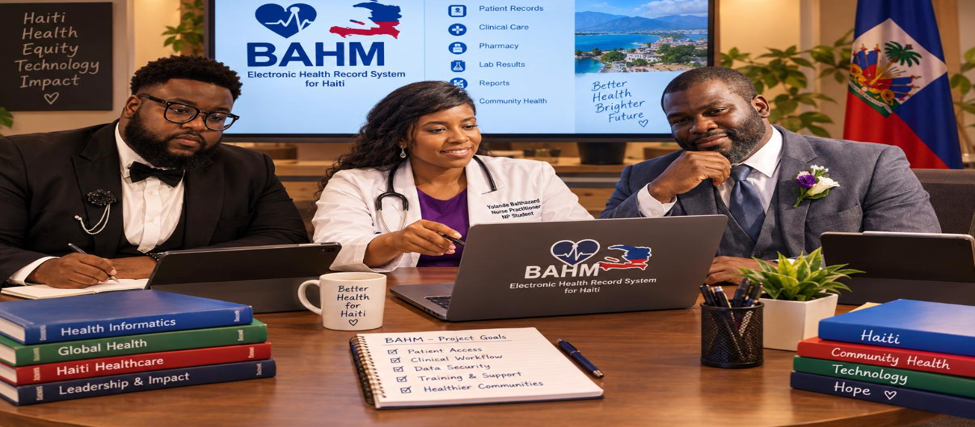
BAHM — Balthazard Health Monitoring — started with a simple question.
When I was accepted into the Family Nurse Practitioner program at Texas Woman's University, I knew I wanted the degree to mean more than a title. I started thinking about where care was needed most — and kept coming back to northern Haiti, a region close to my heart, where access to consistent healthcare is a daily struggle.
That's where the idea for a mobile clinic was born. My husband, who has a background in information technology, offered to help by building a simple electronic health record to keep track of patients as we saw them. A name here, a visit note there.
But the more I worked in the field, the more I realized how much a good record system could do. Every new tab I asked him to add — medications, allergies, follow-up dates — showed me a bigger picture: a system that could serve not just one mobile clinic, but hospitals, clinics, and pharmacies across an entire region, all connected, all speaking the same language.
As my husband and I got deeper into the technicalities and feasibility of actually building this, it became clear the project needed more than the two of us. We've known each other since elementary school — we came up through part of high school together too — so when we sat down to brainstorm who else belonged on this journey, one name surfaced immediately: a former classmate who, years earlier, had helped me organize donations to Haiti after an earthquake, and who has shown up for every cause tied to Haiti ever since. I turned to my husband and said, "I found the 3rd musketeer."
That's BAHM today: a nurse, an IT professional, and a lifelong advocate for Haiti — building, from the ground up, an EHR platform designed for the realities of care in under-resourced communities.